Last week, an automation dimmed the bathroom lights while a person was in the shower. By the next morning, a written document existed. It recorded the trigger, the reason the routine thought the room was empty, and the change. A rule sits at the top in plain language: nobody gets dimmed mid-shower, ever. The repair was small. A lit bathroom now counts as occupied, and the routine skips it. But the document is the part I want to defend.
I write incident reports about my own house. The power fails: it gets a report. The internet cutover at the cottage goes wrong: it gets a report. A forgotten process takes the family AI offline: it gets a report. The shape is the same one software teams use for production outages: timeline, root cause, what held, what failed, what changes. I know how this sounds. My house has a paper trail like a mid-sized SaaS company. But I did this for approximately one year. I now count it among my most valuable habits. This is my case.
Three wrong theories, kept
The document outlives the adrenaline. In the middle of an outage, you are certain of your memory. You will remember the sequence, the wrong guesses, and the repair you promised. You will not. During a power failure this summer, I moved through three confident, wrong theories about the UPS battery. (I told that story in full in another post.) Then the historical telemetry proved one fact: the battery was good the full time. The battery simply did its job. The postmortem keeps all three wrong guesses, on purpose, under one note: pull the history before you make theories from a single reading. Six months from now, mid-outage, past me will warn present me away from the exact ditch he drove into.
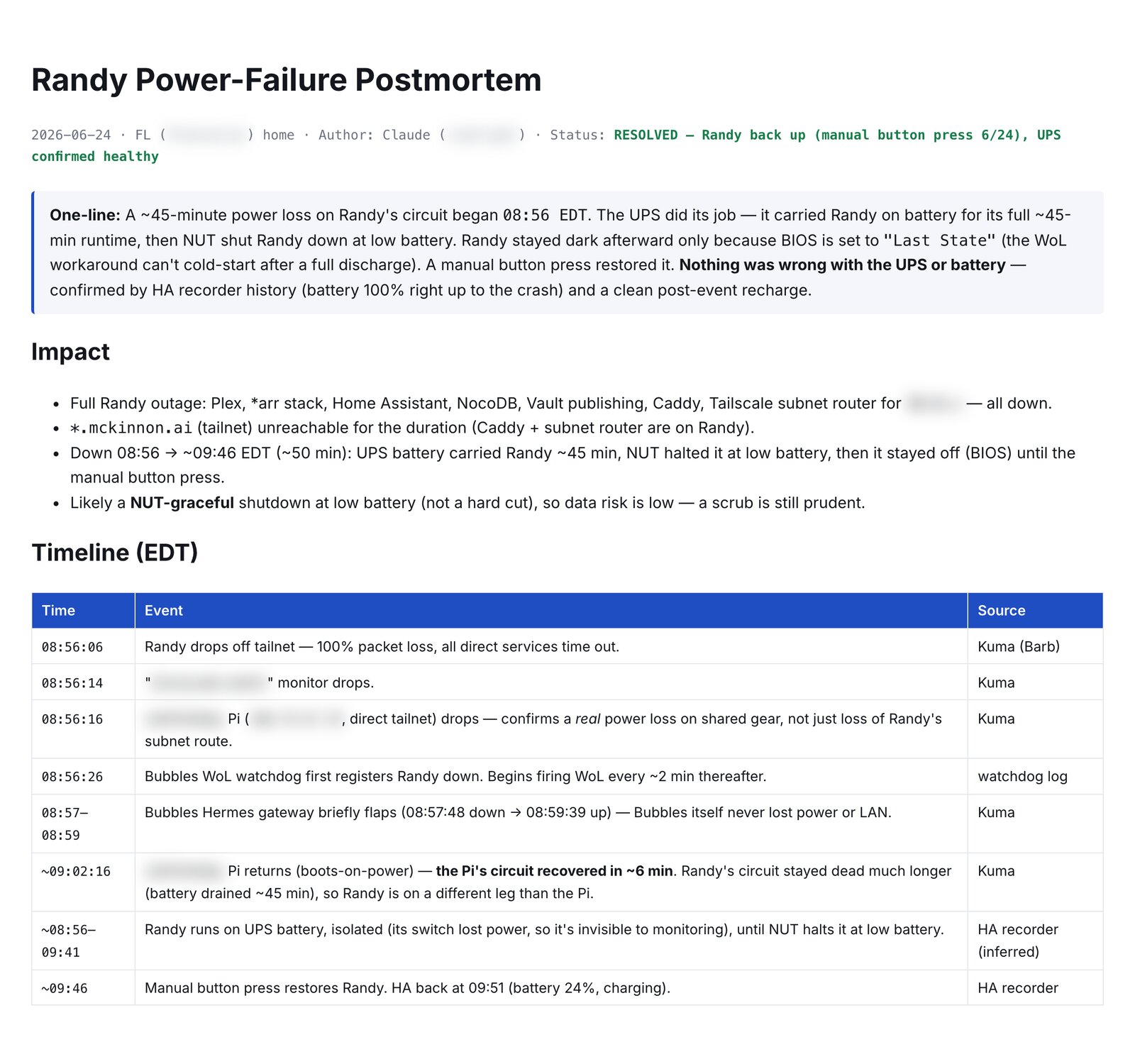
The repair that was not there
The document forces a test of the repair. When you write “what changed”, you must check that it changed. The best example embarrasses me. A reboot problem broke device discovery for almost every speaker and streaming box in the house. I wrote the repair into the document: a small startup task that prevents the conflict. Months later, I updated that same document. I compared the live system against the document’s claim. The startup task was not there. Nobody added it again after a rebuild. Nothing was on fire. The repair was simply absent, in silence. It waited for the next reboot to replay the full outage. No mental model catches that. The written record disagreed with reality. The disagreement is what surfaced the problem. A repair that exists only in your memory is a rumor.
Why the thermostat is like that
You can read the reason. You do not argue it again. Each setting in a house is a decision that a person made under conditions that nobody remembers. Why is the thermostat’s own schedule off? Why does one kitchen light turn on thirty seconds after the others? Without the document, each question becomes a fresh debate. The most confident person usually wins the debate. In a household debate about a setting, confidence and information are inversely correlated. With the document, the answer is a paragraph: what occurred, what we tried, and why the setting is this way. The cottage internet cutover postmortem is my favorite example. The technically hard part worked on the first try. The one-hour outage came fully from me. I swapped a fiber cable back and forth without patience, and I worked from guessed credentials. The action items are not clever: confirm the login before you start; decide, commit, and give the equipment fifteen quiet minutes. Without the document, I would learn both lessons again the hard way at the next property. Instead, the lessons are written down, a little humiliating, and permanent.
What breaks next time
The last section of a good postmortem is “what breaks next time”. That section changes behavior. The power-failure report ends with an admission: most of the repairs were defense-in-depth around one BIOS setting, and that one setting was the true cause. The shower report notes one gap: the cleanup timer resets on a restart. So a rare stray light can stay on until morning. We accept that. It is a known gap, chosen, not discovered.
None of this requires a home run like an ops team. Clearly, I run mine like one. It requires approximately twenty minutes after a failure, while your memory is fresh. Write what occurred and what you changed. The house does not care. But the next version of you will stand in the dark with a flashlight and a theory. He will care.